The Reflective Advantage: A Leadership Tool To Learn More From Experience & Hedge AI

Too often, and for all too familiar of reasons, we don’t take the time to reflect. 35mm photo by Matthew Kurkjian.
“We do not learn from experience- we learn from reflection on experience.”
- John Dewey
Fleeting Present and Persistent Past
I distinctly remember a University of California, Santa Cruz, professor of metaphysics in the philosophy department lecturing to a hall of undergraduates (myself one) and he challenged us to think of the present moment. Though, of course, I was able to think of a moment, like the one in which he made the request, he quickly reminded us, “The second you’re able to think of a moment, it is now the past and not the present. You cannot think of the present.” I think I first comprehended then how truly fleeting the present is. It was terrifying.
Nonetheless, summoning our courage and bringing us to the topic at hand, business leadership and not metaphysics, we must use what we can know, the past, to make a plan for what we can’t know, the future.
Untapped Potential
Permit me a metaphor: if past experiences were a gem mine, and if learning opportunities from past experiences were gems to be discovered, it would likely astound us the value we leave untapped.
Reflection is our tool to mine these unfound gems with which we enrich our lives. Reflection allows us to get more value out of experiences we’ve already “paid” for. Reflection is the key to discovering the foundations of our successes, failures, and ultimately our happiness. In this sense, I grasp why Einstein said if given 1 hour to solve a problem, 55 minutes would be spent ensuring he is asking the right question.
We humans are quite susceptible to lapses in attention, so, we can’t be too hard on ourselves when we do take the time to reflect and comprehend that, in retrospect, we may have had more control over past wins and losses than we previously assumed. Invariably, through reflection, we’ll learn how our behavior either contributes to or works against achieving our goals. This gives us the opportunity to put past learnings into practice and to improve ourselves, which fundamentally, is the root concept of positive psychology: that we can learn about our behavior and change it for the better.
Our Brains vs AI
As January closes, I propose a return to reflection processes in 2026 for business leaders (at least us human ones) who have strayed away from taking the time to do so. As McKinsey & Company coin terms like Brain Economy to distinguish the value our minds hold against AI, undoubtedly, taking time to improve our own brain’s ability to learn from experiences unavailable to AI databases is a potential advantage worth exploring. The future may be uncertain, but we do control how we learn from the past. Leave no stone unturned.
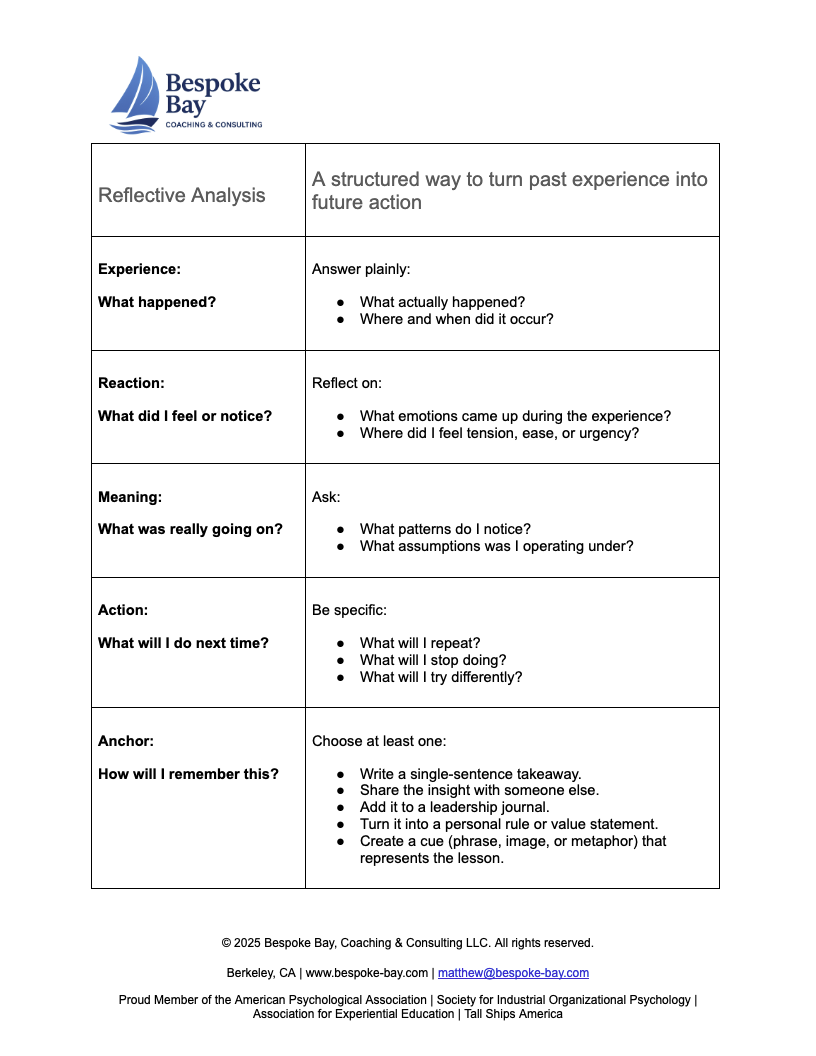
I created a short template below for leaders to structure reflections on business performance, personal goals, academic research, or any goal, really. The process incorporates elements of Dr. David Kolb’s experiential learning theory, positive psychology, and my action-oriented practitioner’s approach. Please download it to use it freely and share any thoughts with me openly.